
Reliable field data. Clear operational visibility.
Instrumentation systems have to function in harsh environments, over unreliable networks, often for years at a time. We design practical measurement, data acquisition and communications architectures for remote and distributed monitoring.
Geotechnical & structural instrumentation
Vibrating-wire and MEMS instruments are only as good as the chain behind them: excitation, sampling, timestamping, calibration records and the path back to a dashboard somebody trusts. We design that chain end to end.
Thresholds are set by the engineer responsible for the asset, not by software defaults. Raw channels are retained alongside processed values, so any alert can be reconstructed later, and the exports are usable by a reviewer who has to sign them.
- Piezometers
- Vibrating-wire and MEMS, with excitation and sampling appropriate to the instrument.
- Inclinometers
- In-place and portable arrays, with orientation and baseline handled properly.
- Load cells & strain
- Bridge and structural measurement, including temperature compensation.
- Acquisition
- Loggers, multiplexers and the field wiring detail that decides data quality.
- Telemetry
- LoRa, cellular and satellite backhaul, chosen per site and power budget.
- Alerting
- Threshold logic, escalation and an audit trail behind every notification.
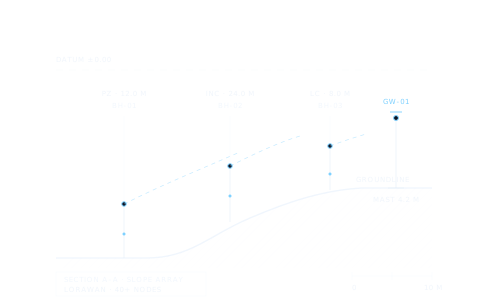
A section through a monitored slope
A typical array: three instrumented boreholes on a rising slope, each with its own instrument type and depth, reporting over long-range radio to a gateway with cellular backhaul. The engineering is in the sampling, the timing and the failure behaviour, not in the dots on the drawing.
Systems are specified to keep logging through a backhaul outage and to make the gap visible when they cannot. A record that omits its own outages is worse than no record.
What tends to go wrong
- Instruments outlive their installers
- Hardware with no documentation, spares or calibration path becomes scrap in three years.
- Dashboards nobody opens
- If an alert does not arrive where work is planned, the system is a report, not monitoring.
- Data that cannot be defended
- No raw record, no calibration reference, no clock discipline means nothing to stand behind.
- Coverage chosen by price
- A network that misses the one location that moves is a false negative, not a saving.
Tell us the asset and what happens if it fails.
That single answer usually decides the architecture before any hardware is discussed.