The same engineering, at home scale

Five disciplines for private estates and large properties: the network backbone, Wi-Fi to the property line, layered security, monitoring, and cameras. One team accountable for all of it.

Why a house needs an engineer

A large property is no longer a house with a router in it. It is a small campus: a gatehouse, guest house, pool house, outbuildings, dozens of access points, cameras, intercoms, access control, smart devices from a dozen vendors, staff and guests on the same wire as the family.

Consumer equipment is not built for that, and neither is a single contractor who runs cable and leaves. The work is systems engineering: redundancy, segmentation, radio planning, power, monitoring. It is what we already do on industrial sites.

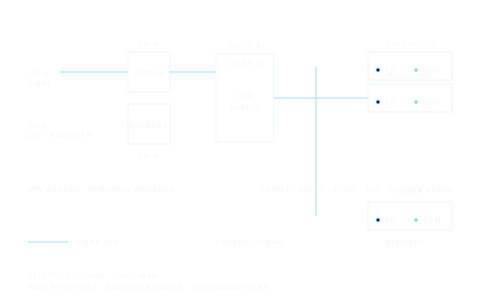
Estate network topology: two internet services into a paired firewall and redundant core, fibre to each structure with access points and cameras
Fig. 06 · Estate topologyDual WAN · redundant core

Five disciplines

Networking

A backbone built to stay up. Two internet providers with automatic failover, paired firewalls, a redundant core, and 10G fibre between structures, so a cut line or a failed switch is an event nobody in the house notices.

Battery-backed power with remote control, loop and storm protection on the access layer, PoE++ where the devices need it, segmentation and priority for voice and video, SD-WAN and VPN for remote access, plus cabling design and certification so the physical layer is documented rather than guessed at.

Dual WAN failoverHA firewall pairRedundant core10G fibrePoE++Cabling certification

Wireless

Coverage to the property line, on enterprise access points rather than consumer mesh. We design from a predictive model, then prove it with an on-site survey: measured signal, channel plan and roaming behaviour in every room, terrace, pool deck and outbuilding.

Seamless roaming that survives a call from the primary suite to the pool, multi-gigabit throughput where the wired network can deliver it, resilient meshing where cable cannot go, and separate encrypted networks for family, guests, staff and smart devices.

Predictive designOn-site surveyFast roamingMulti-gigabitPer-group SSIDs

Cybersecurity

Firewalls stop the obvious. Most incidents arrive through a stolen password or a compromised smart device, so the defence is layered: policy at the edge, intrusion prevention behind it, segmentation that keeps a thermostat off the same network as the family's laptops, and hardened infrastructure underneath.

We start with an assessment of what is actually exposed, in plain language and ranked by what matters, then fix the doors: remote access with MFA, content filtering, firmware discipline, and a documented set of rules somebody can audit next year.

AssessmentFirewall & IPSSegmentationMFA remote accessSmart-device review

Monitoring

We know before you do. Internet links and failover state, firewalls, Wi-Fi, switches, power and UPS, temperature and environment, backup completion. All of it watched continuously and acted on remotely, so problems are usually resolved before anyone at the property notices.

The reporting is deliberately plain: what changed, what was done, what is still open. Where staff or an integrator need access, they get scoped access, not the keys to everything.

Link & failoverDevice healthPower & environmentBackup verificationRemote management

Cameras

Every angle, intelligently watched. Verkada cameras, video intercoms and access control on a network designed to carry them: AI search by description, licence-plate recognition, alerts only for what matters, live view from anywhere, and no recorders in a cupboard to fail.

Cameras are only as good as the network under them, so they get their own VLAN, a planned PoE budget and monitored uplinks. Footage stays under the owner's control, with sharing scoped per person and per door.

People & vehicle AIPlate recognitionIntercomsAccess controlDedicated VLAN

Custom AI surveillance

Most camera systems are recorders. We build something different: an inference layer that runs on hardware at the property, watches every stream, and produces events that already mean something: a person at the north gate at 02:14, a vehicle whose plate is on the list, a package left on the porch, glass breaking in the east wing.

It is deliberately outside the appliance menu. No subscription tier decides which detections you are allowed; we choose the models, the zones and the retention to fit the property, and you can read every rule we write.

Discuss a surveillance design

Local inference
Detection on every stream at the property: people, vehicles, animals, packages. Nothing is sent to a cloud service unless you ask for it.
Object states
Not just presence: a car parked versus arriving, a person at the door versus walking past, a package left versus collected.
Zones and schedules
Driveway, pool deck, gatehouse, service yard, perimeter: different sensitivities, different hours, different people notified.
Face recognition
Household and staff enrolled; an unknown face is a separate event from a resident's late arrival, and is handled separately.
Plate recognition
Every plate at the gate read and matched against a known-vehicle list, with no barrier tag required and no cloud lookup.
Audio events
Breaking glass, alarms, raised voices, a dog in distress, where they carry meaning and on the cameras that cover them.
Search by description
"White SUV at the gate after nine": described in words, answered from the footage across every camera at once.
Retention by value
Events kept by type, continuous coverage where it matters, clips exported with the metadata that makes them evidence.

Automation that reaches the whole property

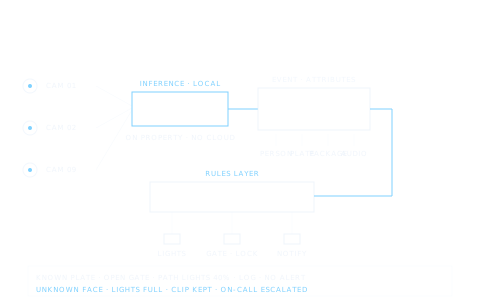
A camera that only sends notifications is half a system. The other half is what happens next. We build a local rules layer that joins cameras, gates, doors, locks, lighting, climate, audio and access control into one fabric, so a detection can move something real instead of adding to a queue nobody reads.

The logic is ordinary engineering: a condition, a set of constraints, an action, an escalation, all written down, versioned and testable. It is not a phone-app scene builder and it is not tied to one vendor's ecosystem.

Event pipeline: camera streams feed local inference, which emits an event with attributes that the rules layer turns into actions
Fig. 07 · Event pipelineDetect · decide · act

Arrival

A plate on the list at the gate opens it, takes the driveway lights to forty percent, logs the entry and tells nobody, because there is nothing to tell. An unrecognised plate after dark goes the other way: lights to full, a clip attached to the alert, and the person on call gets the plate read, not a fifteen-second video.

Movement

Path lighting can follow a resident walking the property at night, with cameras re-prioritising that area and no alert raised, while the same movement from an unknown person escalates: exterior lights, a spoken announcement in that zone, and the duty phone. Same detection, two different sets of rules.

Delivery

A package recognised on the porch produces one notification with the frame, keeps the clip under the delivery event rather than in a generic queue, and, if the porch is a place things go missing, starts a timer that turns on the entry lights and reminds somebody in the house.

Absence

Nobody home and a face that is not enrolled: locks confirmed, blinds or scenes set to occupied, interior cameras armed, and an escalation path that does not depend on someone watching a screen at two in the morning.

The rest of the property

The same rules layer covers things cameras cannot see: a gate or garage left open beyond a set time, a leak sensor closing a valve, a temperature excursion in a wine room or plant room, a UPS on battery. Each one is a condition with an action and a record, not an app you have to remember to open.

Local by design

The inference, the rules and the recording all run on hardware at the property. There is no subscription that decides which detections exist, and when the internet uplink drops the property keeps watching, deciding and acting. Where a cloud service is genuinely useful, off-site backup of events for instance, it is a choice, scoped and encrypted, not a dependency.

From first survey to the years after

01Survey

The property, the structures, the cable routes, the radio environment and what the household actually does on the network.

02Design

Topology, redundancy level, access-point placement, VLAN plan, camera coverage and a bill of materials with second sources.

03Pre-deployment

Everything configured and tested on the bench before a single wall is opened. Cutover planned around the household, not around us.

04Install

Cabling, racks, access points and cameras installed to a standard, then certified: post-install survey, failover test, throughput test, camera coverage check.

OngoingWatch

Monitoring, firmware discipline, backup verification and a named path for support. Documented so any competent engineer could take it over.

Building, renovating, or inheriting a network you cannot explain?

Send the property, the structures and what has to work. We will tell you what the design should be before anyone quotes hardware.

Start the conversation